Importance of healing
The core of a cultural and spiritual room is all about helping an individual heal in whatever way that may look like to them. Recent studies suggest a positive association between health behaviors and spirituality with the overall well-being of an individual (Bozek, 2020). Healing can look different for every individual, whether that be healing through spiritual methods, practices unique to your culture, or a different method special to you. Knowing what form of healing works for you can have a positive impact on not just your overall well-being but can help provide a framework of skills you can utilize in times of crisis.
Forms of cultural and spiritual healing
At First Witness, we embrace and welcome people of all cultures and ethnic backgrounds. We understand that healing may look different dependent upon which culture you identify yourself with. Some healing practices are unique to specific cultures such as the Indigenous Traditional Healing practice that aims to treat imbalances in a person’s spirit, mind, body, and emotions. Healing Circles are an example of an Indigenous Healing Practicing that involves a leader, facilitator, or elder that will open with a prayer. A talking stick is passed around a circle, allowing everyone a moment to speak. This is a moment to pour out their thoughts, emotions, and feelings and gain support. Another healing practice belonging to the Japanese culture is the tradition of Ikebana. Ikebana involves flower arranging, which is a meditative practice that centers around creating inner peace as you carefully arrange each flower.
In addition to healing via a cultural tradition, healing can also take place in a spiritual manner. Spiritual practices acknowledge the interconnectedness of the mind, body, and spirit. Some spiritual practices can include meditation, yoga, shamanic healing, and faith healing with prayer and gestures. Regardless of if you belong to a religious affiliation or not, spiritual healing can make a positive impact on your well-being and can be beneficial in time of crisis.
Implementation of the Cultural and Spiritual Room at First Witness
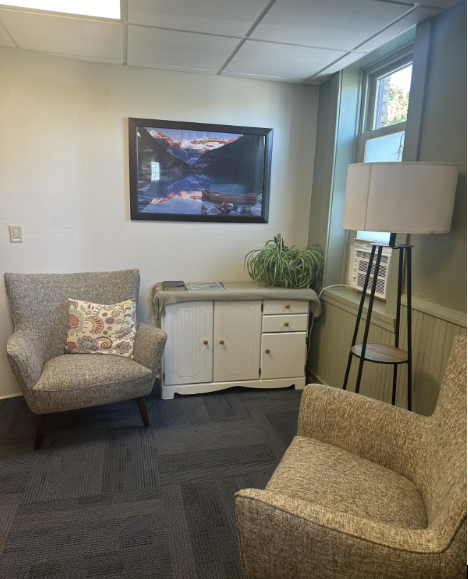
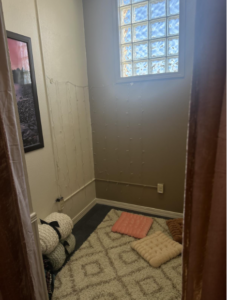
Before the Cultural and Spiritual Room was a reality, it began as an idea. First Witness’ Associate Director, Tyra Jaramillo-Kraemer was essential in bringing this idea to life. When First Witness moved into our new space in January of 2024, Tyra, along with other members of the staff at First Witness and other spiritual and cultural leaders within the community formed a focus group to discuss their vision. When the group was envisioning their ideas, they considered that standard talk therapy doesn’t always work for everyone, and they found it important to cater to everyone’s healing journey. Oftentimes, spirituality plays a large role in how people, especially children, process trauma. Because of this, the utmost importance was placed on creating an adaptable space that was able to transform into whatever would aid the individual in healing best. The Cultural and Spiritual Room includes a welcome space for the practice of Smudging, beading, crystal use, as well as a relaxing space for folks who utilize a calm zone where they can practice meditation or any calming techniques in a quiet, dimly lit space. In addition, our spaces also include tarot cards, prayer mats for folks who identify with the Islamic religion, as well as religious texts and books for almost every spiritual/religious affiliation.
Spiritual Care Program
Here at First Witness, we are also expanding our connections within the community by adding a Spiritual Care Provider to our services. Upon the request of the caregiver, our Spiritual Care Provider works with the caregiver and the advocate to process emotions through a trauma-informed spiritual lens. This can look very different dependent upon the caregivers’ needs, which aligns with our goal of giving families back their autonomy and decision making. Our Spiritual Care Provider has extensive experience and is involved in the Duluth community, which makes her a strong asset to our team. Additionally, our Cultural and Spiritual Committe has been reaching out to religious, spiritual, and cultural leaders with the hope of building our knowledge to provide services that fit everyone’s need. To make this information more accessible and concise, we are in the process of creating a pamphlet to hand out to caregivers. This will lay out the purpose of our space and hopefully provide families with comfort, knowing that we accept and encourage their specific healing journeys. Overall, our mission is to create an adaptable space through an unbiased perspective with the knowledge that healing looks different for every individual.
References
Bożek, A., Nowak, P. F., & Blukacz, M. (2020, August 14). The relationship between spirituality, health-related behavior, and psychological well-being. Frontiers in psychology. https://www.ncbi.nlm.nih.gov/pmc/articles/PMC7457021/
CBCN Team. (2020, June 22). Indigenous traditional healing. Canadian Breast Cancer Network.https://cbcn.ca/en/blog/our-stories/Indigenous-Traditional-Healing
Dientsman, A. M. (2022, January 5). 6 healing rituals from around the world – GoodNet. https://www.goodnet.org/articles/6-healing-rituals-from-around-world